
Sitemap
A list of all the posts and pages found on the site. For you robots out there, there is an XML version available for digesting as well.
Pages
Posts
Future Blog Post
Published:
This post will show up by default. To disable scheduling of future posts, edit config.yml and set future: false.
Blog Post number 4
Published:
This is a sample blog post. Lorem ipsum I can’t remember the rest of lorem ipsum and don’t have an internet connection right now. Testing testing testing this blog post. Blog posts are cool.
Blog Post number 3
Published:
This is a sample blog post. Lorem ipsum I can’t remember the rest of lorem ipsum and don’t have an internet connection right now. Testing testing testing this blog post. Blog posts are cool.
Blog Post number 2
Published:
This is a sample blog post. Lorem ipsum I can’t remember the rest of lorem ipsum and don’t have an internet connection right now. Testing testing testing this blog post. Blog posts are cool.
Blog Post number 1
Published:
This is a sample blog post. Lorem ipsum I can’t remember the rest of lorem ipsum and don’t have an internet connection right now. Testing testing testing this blog post. Blog posts are cool.
portfolio
Portfolio item number 1
Short description of portfolio item number 1
Portfolio item number 2
Short description of portfolio item number 2
publications
Design and Implementation of a Semi-Autonomous Robotic System for Systematic Solar Panel Cleaning
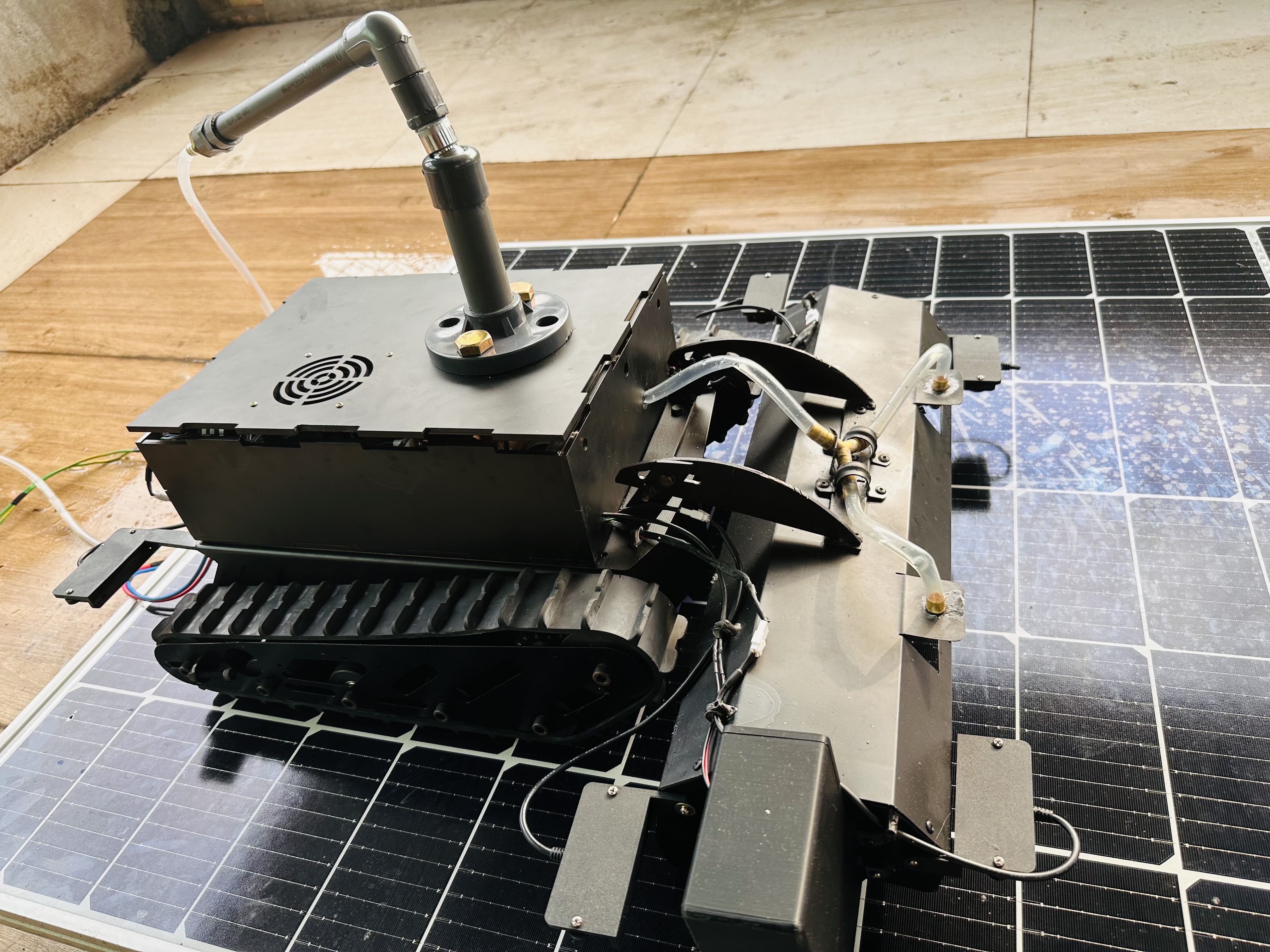
Published in 9th International Conference on Control and Robotics Engineering (ICCRE), 2024
Solar photovoltaic (PV) systems have become a trend as a sustainable energy source on a global scale. However, the dirt accumulated on solar panels often reduces their efficiency, considerably. Existing cleaning methods have limitations such as requiring manual labour, low efficiency, limited to single cleaning method or single operational mode. As a solution, this research study describes the design and implementation of a semi-autonomous solar panel cleaning robot for both dry and wet cleaning. The robot can autonomously navigate on solar panels safely, or user can manually control it using a mobile app. The robot is capable of functioning for around 75 minutes on a single charge on solar panels tilted up to 20°, facilitated by image processing algorithms achieving an accuracy surpassing 96%. The orientation estimation is accomplished through the implementation of three parallel Kalman filters running on an embedded system. Experiments and simulations conducted using the implemented mobile robot show the effectiveness of the proposed robot design.
Recommended citation: Isuru Munasinghe, Vishva Vijenayake, Sahan Viduranga, Yomali Lokugama, Peshala Jayasekara, "Design and Implementation of a Semi-Autonomous Robotic System for Systematic Solar Panel Cleaning.", 9th International Conference on Control and Robotics Engineering (ICCRE), Osaka, Japan, 2024, pp. 61-67, http://dx.doi.org/10.1109/ICCRE61448.2024.10589856
Download Paper
A Comprehensive Review of UAV-UGV Collaboration: Advancements and Challenges
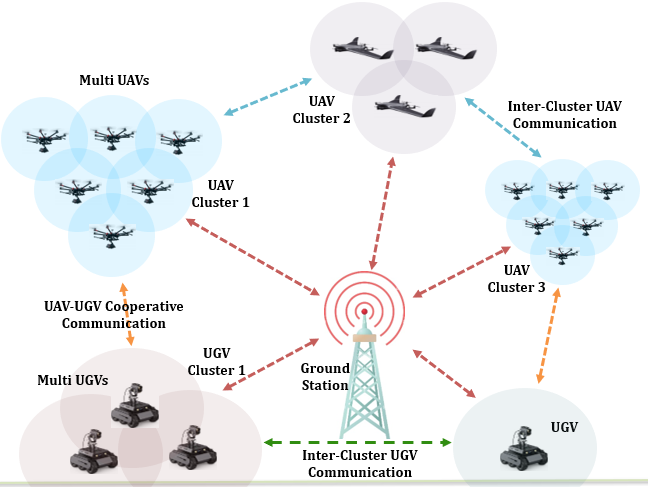
Published in Journal of Sensor and Actuator Networks (JSAN), 2024
Unmanned aerial vehicles (UAVs) and unmanned ground vehicles (UGVs) have rapidly evolved, becoming integral to various applications such as environmental monitoring, disaster response, and precision agriculture. This paper provides a comprehensive review of the advancements and the challenges in UAV-UGV collaboration and its potential applications. These systems offer enhanced situational awareness and operational efficiency, enabling complex tasks that are beyond the capabilities of individual systems by leveraging the complementary strengths of UAVs and UGVs. Key areas explored in this review include multi-UAV and multi-UGV systems, collaborative aerial and ground operations, and the communication and coordination mechanisms that support these collaborative efforts. Furthermore, this paper discusses potential limitations, challenges and future research directions, and considers issues such as computational constraints, communication network instability, and environmental adaptability. The review also provides a detailed analysis of how these issues impact the effectiveness of UAV-UGV collaboration.
Recommended citation: Isuru Munasinghe, Asanka Perera, and Ravinesh C. Deo, "A Comprehensive Review of UAV-UGV Collaboration: Advancements and Challenges", Journal of Sensor and Actuator Networks, vol. 13, no. 6, p. 81, 2024. https://doi.org/10.3390/jsan13060081
Download Paper
Improving Navigation of a Semi-Autonomous Solar Panel Cleaning Robot through Advanced Localization and Edge Detection
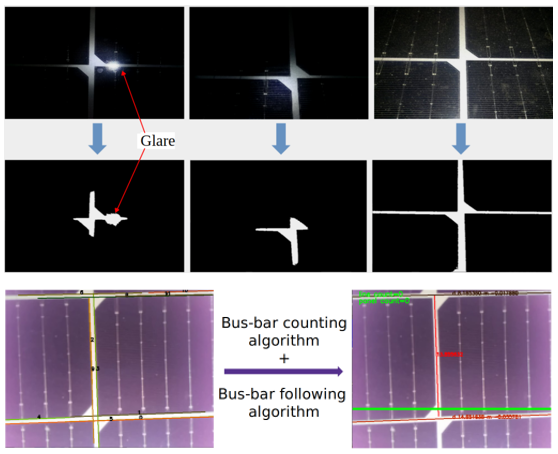
Published in International Journal of Science, Engineering and Management (IJSEM), 2025
Solar photovoltaic (PV) systems have become increasingly popular as a sustainable energy source due to the growing need for renewable energy on a global scale. However, the buildup of dust and dirt on solar panels frequently compromises the effectiveness of these systems. Existing cleaning methods often require manual labor, exhibit low efficiency, and are restricted to either a single cleaning method or operational mode. To address these issues, we designed and implemented a semi-autonomous solar panel cleaning robot capable of both dry and wet cleaning. The robot can autonomously navigate on solar panels with a tilt of up to 20° or be manually controlled using a mobile app, and it operates for approximately 75 minutes on a single charge. This study enhances key aspects of the robotic system, integrating advanced edge detection and transition mechanisms using both ultrasonic sensors and image processing techniques. We implemented a robust localization system based on bus-bar detection for precise navigation, upgraded the water supply mechanism and refined the orientation estimation algorithm.
Recommended citation: I. Munasinghe, V. Vijenayake, and P. Jayasekara, International Journal of Science, Engineering and Management (IJSEM), 12(1), 9–14. 2025. https://doi.org/10.36647/IJSEM/12.01.A001
Download Paper
Design and Performance Optimization of a Low-Power Half-Bridge LLC Resonant Converter Using GaN FETs
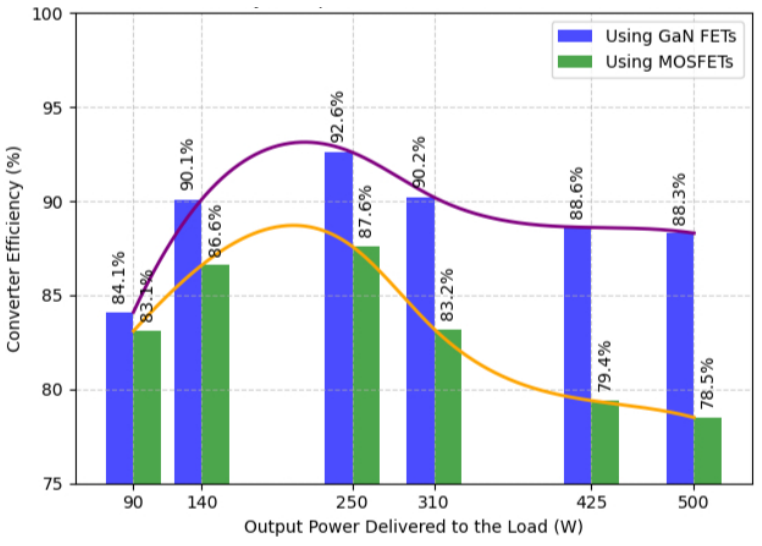
Published in 15th International Conference on Electrical Engineering (ICEENG), 2025
This paper presents the design, implementation, and experimental validation of a cost-effective 500W half-bridge LLC resonant DC-DC converter optimized for high-efficiency, low-power applications. The converter utilizes Gallium Nitride (GaN) FETs, achieving a peak efficiency of around 90% to meet the increasing demand for compact and reliable power conversion in the renewable energy, industrial automation, and telecommunication sectors. It operates with a nominal input voltage of 72V (in a range of 63 to 75V) and delivers a 14.5V/40A output. The resonant tank design methodology ensures exclusive inductive region operation, enabling zero voltage switching (ZVS) under all load conditions to minimize switching losses, electromagnetic interference (EMI), and device stress. Experimental results demonstrate a 1–10% efficiency improvement using GaN FETs over traditional MOSFETs, particularly at higher power levels. The design incorporates an adaptive protection framework that includes configurable over-voltage, under-voltage, and over-current precautions to ensure resilience under transient and fault conditions. We confirm stable operation at a 100kHz switching frequency through comprehensive load-varying tests, maintaining high efficiency across different load conditions.
Recommended citation: Isuru Munasinghe, Ashen Rodrigo, "Design and Performance Optimization of a Low-Power Half-Bridge LLC Resonant Converter Using GaN FETs," 15th International Conference on Electrical Engineering (ICEENG), Cairo, Egypt, 2025, pp. 1-6, http://dx.doi.org/10.1109/ICEENG64546.2025.11031338
Download Paper
talks
Talk 1 on Relevant Topic in Your Field
Published:
This is a description of your talk, which is a markdown file that can be all markdown-ified like any other post. Yay markdown!
Conference Proceeding talk 3 on Relevant Topic in Your Field
Published:
This is a description of your conference proceedings talk, note the different field in type. You can put anything in this field.
teaching
Module: EN2091 – Teaching and Instructing
Undergraduate course, Department of Electronic and Telecommunication Engineering, University of Moratuwa., 2023
Conducted instructional sessions for Module EN2091 – Laboratory Practices and Projects, focusing on laboratory experiments in Analog Electronics, Digital Electronics, and Fundamentals of Computer Organization and Design.